- Benzinga Tech Trends
- Posts
- ChatGPT Gets The Apple Treatment
ChatGPT Gets The Apple Treatment

Benzinga Tech Trends
May 19, 2026

The relationship between Big Tech giants is often sold as a win-win. A strategic partnership here, a seamless integration there, and suddenly, two ecosystems are supposed to grow together.
But in reality, those alliances are rarely equal. And when expectations don’t match execution, friction tends to follow.
That’s exactly what is now unfolding between Apple and OpenAI, according to a news report that suggests the ChatGPT maker is increasingly frustrated with how its flagship iPhone integration has played out.
When A Dream Partnership Starts Feeling One-Sided
The partnership, announced at Apple’s Worldwide Developers Conference in 2024, was meant to be a defining moment for mobile AI. It integrated ChatGPT into Apple’s ecosystem, including Siri and Apple’s Visual Intelligence features, allowing users to access AI assistance directly on iPhones.
On paper, the logic was simple. Apple would get a powerful generative AI boost without building everything from scratch, while OpenAI would gain unprecedented distribution across hundreds of millions of devices.
For a company chasing mainstream consumer adoption, the iPhone looked like the perfect launchpad.
But according to the report, the reality has been far less exciting for OpenAI.
Why OpenAI Is Growing Frustrated With Apple Integration
OpenAI reportedly believes the integration has not delivered the visibility or subscription growth it expected. Features tied to ChatGPT are said to be buried within Apple’s interface, making them difficult for users to discover organically.
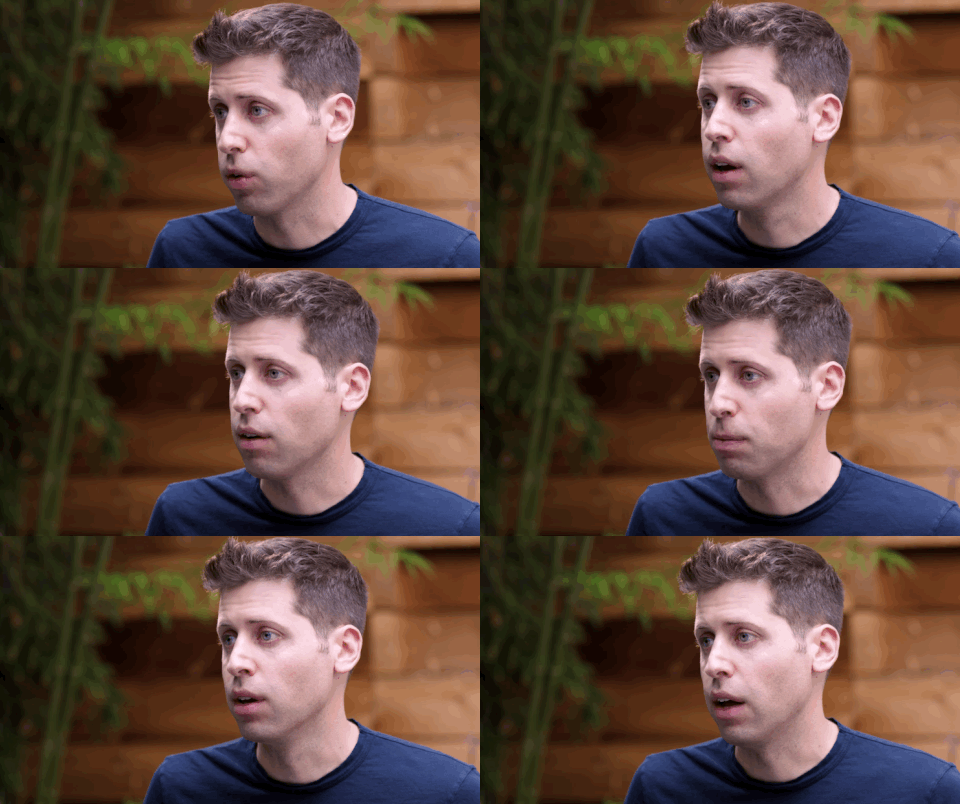
The company had reportedly projected that the partnership would funnel significant subscription revenue through iPhone users. Instead, internal frustration has grown as adoption metrics fall short of expectations.
One of the core issues appears to be control. While OpenAI built the intelligence layer, Apple controls the interface, placement, and user experience. And in Apple’s ecosystem, visibility is everything.
Apple’s Walled Garden Problem Comes Into Focus
For Apple, this is business as usual. The company has long maintained strict control over how third-party services appear on its devices. That control is part of what makes Apple’s ecosystem so polished—but also what frustrates many partners.
In this case, OpenAI reportedly feels that Apple has not prioritized the ChatGPT experience within iOS in a way that would maximize usage.
Apple, however, has its own concerns, including privacy considerations around AI integrations and broader competitive tensions as OpenAI expands beyond software into hardware ambitions.
That tension is not new in Apple’s world. It has played out before with major partners who later became rivals or critics.
A Familiar Pattern Of Apple Partner Friction
History offers several examples of Apple’s difficult dance with platform partners. Google Maps was once a core feature of the iPhone before Apple replaced it with its own Apple Maps, a move that sparked widespread criticism at launch.
Adobe’s Flash technology was effectively shut out of Apple’s mobile ecosystem after Steve Jobs publicly argued against it in 2010, accelerating Flash’s decline.
Spotify has also repeatedly accused Apple of using App Store rules to favor Apple Music, a dispute that eventually drew regulatory scrutiny in Europe.
The pattern is consistent. Apple builds platforms that partners want access to, but it also tightly controls how those partners can operate within them. That balance often works until it doesn’t.
Legal Pressure And What Happens Next
The report also suggests OpenAI has begun exploring legal options, including the possibility of a breach-of-contract notice against Apple. While a lawsuit is not imminent, the move signals that frustration has reached a more serious stage.
Any escalation may still be delayed due to OpenAI’s ongoing legal battle with Elon Musk, adding another layer of complexity to an already tense period for the company.
For now, the partnership remains intact. ChatGPT is still integrated into Apple’s ecosystem, and Apple continues to push its own Apple Intelligence strategy. But the underlying tension highlights a broader question in the AI era.
Who really benefits when cutting-edge AI meets tightly controlled platforms?
And more importantly, who gets to decide how visible that AI actually becomes?
This Week In Tech
OpenAI Unveils ChatGPT Finance Dashboard
Intuit has rolled out a new personal finance feature for ChatGPT users. This feature allows users to directly connect to their financial accounts through supported institutions. Currently, the rollout is targeting ChatGPT Pro subscribers in the United States across web and iOS platforms. The feature enables users to track spending, investments, subscriptions, and liabilities through a centralized dashboard.
Anthropic To Brief Finance Ministries On Cyber Risks
Anthropic has reportedly agreed to brief leading finance ministries and central banks on cyber vulnerabilities identified by its general-purpose generative AI model Claude Mythos Preview. This follows a request from Bank of England Governor Andrew Bailey, who chairs the Financial Stability Board. The FSB is preparing a report on sound practices for AI adoption, due next month.
Trump's Investment In Palantir
Records from the U.S. Office of Government Ethics reveal that Trump purchased between roughly $247,000 and $630,000 worth of Palantir stock during the first quarter of 2026. Weeks later, Trump praised Palantir on Truth Social, calling its military technology battle-tested and effective.
Musk-OpenAI Court Battle Enters Jury Phase
The first phase of the Elon Musk vs. OpenAI trial wrapped in federal court in Oakland, California. A nine-person advisory jury will begin deliberations on Monday. U.S. District Judge Yvonne Gonzalez Rogers will ultimately issue the final ruling on liability.
Meta's AI Chief Refutes Talent Poaching Claims
Meta's AI Chief, Wang, has dismissed claims that Meta has been aggressively recruiting top AI researchers from competitors, allegedly offering up to $100 million. Wang emphasized that the recruits were attracted by other factors, such as the opportunity to have a large amount of computing power at their disposal.
That's all for this week! If you found these updates useful, you'll like more from this newsletter. Get deeper dives, hot takes, and all the latest tech news delivered straight to your inbox.