- Benzinga Tech Trends
- Posts
- China’s AI Goes Open-Source. OpenAI Goes... Sponsored?
China’s AI Goes Open-Source. OpenAI Goes... Sponsored?

Benzinga Tech Trends
December 02, 2025

The AI world is splitting into two very different realities, and the divide has never been more obvious than it is this week. On one side, OpenAI is reportedly preparing to roll out something its CEO, Sam Altman, once called “upsetting”: ads inside ChatGPT.
On the other hand, China’s AI ecosystem is unleashing a new wave of open-source models faster than Silicon Valley can process them.
If this feels like a plot twist, that’s because it is. For the first time since the generative AI boom began, the U.S. is playing defense.
ChatGPT Is Becoming Search — And Search Means Ads
ChatGPT was positioned as the clean, premium alternative to the ad-stuffed chaos of Google Search. That era appears to be ending.
Strings uncovered in the latest ChatGPT Android beta reveal references to an “ads feature,” including “search ads carousel,” “bazaar content” and other elements that sound a lot like the blueprint of a full advertising stack.
At first, ads will reportedly surface only inside ChatGPT’s search experience — which is exactly where Google earns most of its revenue.
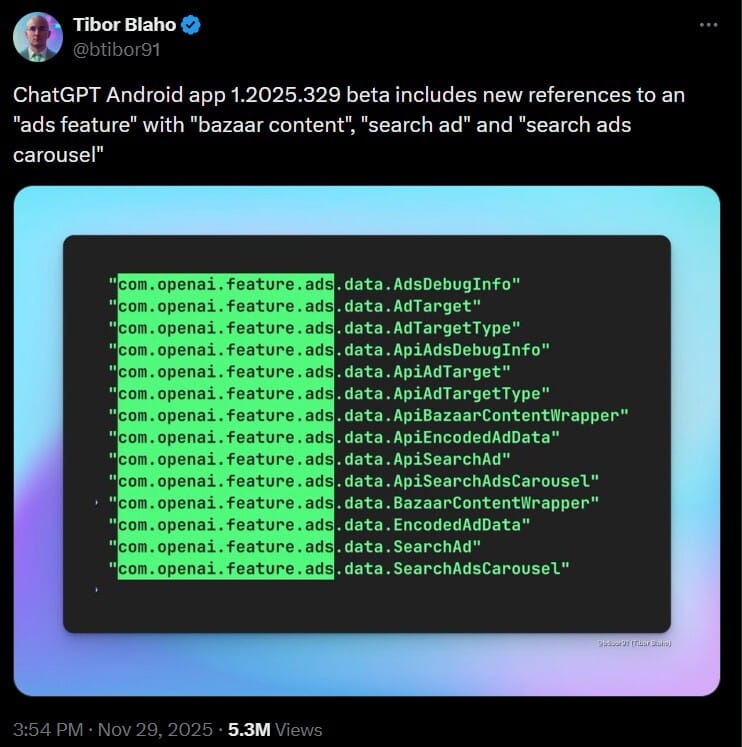
Source: Tibor Blaho/X
This shift is massive. ChatGPT now sees around 800 million weekly users and handles over 2.5 billion prompts a day. It knows what you want, what you’re planning, what you’re curious about, and what you’re about to buy.
That level of intent makes it the most powerful advertising surface ever created. But it also marks a clear pivot: OpenAI is no longer just chasing breakthroughs. It’s chasing Google’s business model.
Meanwhile, China Is Flooding The World With Free AI
While OpenAI experiments with monetization, China is doing the opposite — open-sourcing everything it can, as fast as it can.
DeepSeek kicked off 2025 by shaking Silicon Valley with a model that matched U.S. performance using a fraction of the compute.
Now the company is back with DeepSeek-V3.2-Exp, an experimental spin featuring a new technique called DeepSeek Sparse Attention, which dramatically improves long-context reasoning while cutting operational costs in half.
DeepSeek isn’t an outlier anymore. Alibaba’s Qwen series is evolving at breakneck speed. Baidu, Tencent, Zhipu, MiniMax, and Moonshot are releasing new open models on a monthly cadence.
And what used to be Meta’s open-source playground is now being dominated by China’s LLM engines.
“The DeepSeek Moment,” as investors call it, wasn’t just a hype cycle — it was a signal that China has reached technological parity in open-source AI and in some areas, has surpassed the U.S.
Open Source Vs. Paywall: Two AI Worlds, Two Philosophies
The contrast couldn’t be sharper. China’s strategy is simple: open up the models, accelerate iteration, train developers worldwide, and build global influence by giving away capability.
Strong state funding keeps the engine running, and the result is a fast, chaotic, community-driven ecosystem that improves by the week.
The U.S. strategy is equally clear: build premium, tightly controlled systems like ChatGPT, Gemini, and Claude; bundle them into commercial products; enforce strong safety guardrails; and monetize through subscriptions and — soon (reportedly) — ads.
America is prioritizing stability, legal compliance, and revenue. China is prioritizing scale, experimentation, and adoption.
Google Has Gemini 3, DeepSeek Has Developers
Google earlier this month released Gemini 3 to compete with GPT-5 and Claude. It’s powerful, polished, and deeply integrated into Google’s AI stack.
But DeepSeek’s newest models are already circulating across Hugging Face and GitHub, spawning thousands of forks, fine-tunes, and domain-specific clones. Whatever Google builds, China seems determined to release a free version just months later.
That global adoption matters. In developing markets, free beats premium every time. And while U.S. companies debate pricing tiers, Chinese models are becoming the default engine for startups in Asia, Africa, and Latin America.
The AI Race Is No Longer Just About Models — It’s About Influence
This is the first time China has meaningfully challenged U.S. dominance in an AI stack. And by embracing open-source, it has positioned itself to shape the standards, tooling, and developer culture surrounding AI worldwide.
The U.S. still leads in frontier research, but China is now steering the direction of open AI.
This Week In Tech
Taiwan's Tariff Tussle
Taiwan Semiconductor Manufacturing Company Ltd is at the heart of Taiwan's efforts to secure lower U.S. tariffs. Despite rumors, Taiwan officials clarified that workforce training for U.S. chip manufacturing is not a condition in their ongoing trade negotiations with the U.S.
Pichai's Plea For AI Regulations
Sundar Pichai, CEO of Alphabet Inc., has called for clear, national-level artificial intelligence regulations. He warned that the U.S. could fall behind China in the AI race due to the confusing regulatory patchwork created by over 1,000 AI-related bills currently moving through state legislatures.
Amazon And Google's Multicloud Move
Amazon.com Inc. and Alphabet Inc.’s Google have launched a new multicloud networking service. This service aims to establish private, high-speed links between the two companies’ computing platforms in a matter of minutes, addressing the need for reliable connectivity.
TSMC-Intel Trade Secrets Scandal
The homes of a former Taiwan Semiconductor Manufacturing Co. vice president were raided by Taiwan prosecutors. The chipmaker accused him of passing confidential information to Intel Corp.
Trump's AI Overhaul
President Donald Trump launched the "Genesis Mission," a sweeping national effort to rebuild America's scientific edge. This initiative aims to unify federal scientific resources and embed artificial intelligence into U.S. research infrastructure.
That's all for this week! If you found these updates useful, you'll like more from this newsletter. Get deeper dives, hot takes, and all the latest tech news delivered straight to your inbox.