- Benzinga Tech Trends
- Posts
- Who Controls AI Now?
Who Controls AI Now?

Benzinga Tech Trends
December 16, 2025

This week, the biggest AI story isn’t a flashy new chatbot or a trillion-dollar chip deal.
It’s about power. Specifically: who gets to make the rules for artificial intelligence in the U.S.
Let’s dive into what this fuss is all about:
Washington Just Took The Wheel
On Dec. 11, President Donald Trump signed an executive order that does something bold—and controversial.
It creates a single national framework for AI regulation, effectively blocking states from setting their own rules. To enforce it, the order also sets up a Department of Justice AI Litigation Task Force designed to challenge state-level AI laws in court.
Trump’s argument is simple: You can’t lead in AI if companies need 50 different approvals from 50 different states.
In his view, fragmented regulation doesn’t protect innovation—it chokes it, especially when the U.S. is racing China and other global rivals.
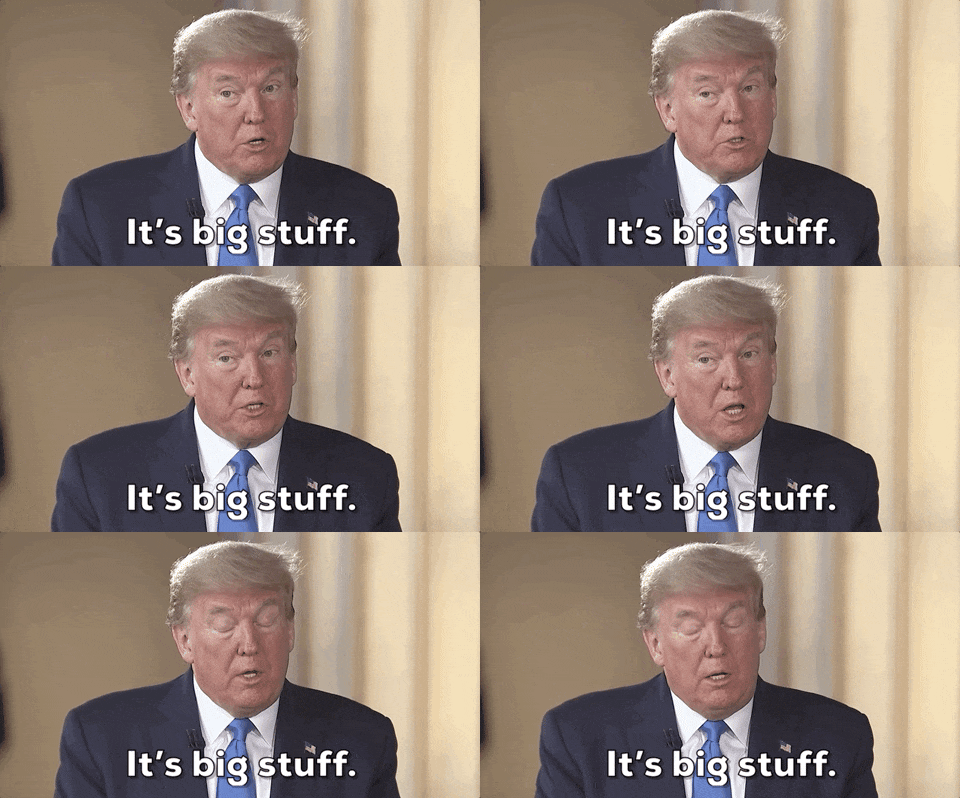
Gif by cbsnews on Giphy
One Rulebook, Or Else…
What makes this even more interesting is how different America’s approach is compared to everyone else:
Europe is going all-in on enforcement, with the EU AI Act banning certain high-risk uses and threatening fines of up to 7% of global revenue. China is tightening oversight, requiring AI-generated content labels and government reviews of algorithms.
Japan is taking a lighter touch, focusing on innovation and voluntary guidelines. The U.K. plans to turn 2025 voluntary AI safety promises into a binding law next year.
The U.S., under Trump, is choosing speed and scale over guardrails—at least for now.
Why States Are Pushing Back
States didn’t wait for Washington.
Texas, California, New York, and Connecticut have all advanced AI laws focused on things like deepfakes, bias, copyright, kids’ safety, and critical infrastructure.
Trump’s order puts many of those efforts directly in the crosshairs.
Supporters say that’s necessary to avoid chaos. Critics argue it wipes out local protections before a strong federal alternative exists.
That tension—innovation vs. oversight—is about to play out in courtrooms.
However, this executive order isn’t just about AI policy. It’s about who gets to shape the future of technology in America. Federal government? State lawmakers? Or the companies building the tools?
For now, Washington is claiming the final say.
Whether that accelerates American AI leadership—or sparks years of legal and political battles—will define the next chapter of the AI era.
And it starts with one question: Who controls AI now?
This Week In Tech
Intel's Potential $1.6 Billion AI Chip Acquisition
Intel Corp. is reportedly in advanced discussions to acquire AI chip startup SambaNova Systems for an estimated $1.6 billion. The deal, which could close as early as next month, would see Intel stepping onto Nvidia's turf. However, SambaNova is also considering other potential investors.
Trump's Decision To Allow Nvidia Chip Sales To China Criticized
Former UK Prime Minister Rishi Sunak has voiced his concerns over President Donald Trump's decision to allow Nvidia to sell its H200 AI chip to China. Sunak warned that it's naive to assume these chips won't be used for military purposes and that this move could enable Beijing to match the West in AI.
Disney Nominates Former Apple Exec For Board Seat
Walt Disney Co. has nominated former Apple Inc. COO Jeff Williams to join its board of directors. If elected at the 2026 annual shareholders meeting, Williams' addition would expand Disney's board from 10 to 11 members.
Meta Incorporates Alibaba's AI Model
Meta Platforms Inc. is reportedly using an open-source AI model built by Alibaba Group Holding Limited to revamp its AI strategy. The new AI model, code-named Avocado, is expected to be released in the spring.
Trump's AI Order Sparks Controversy
President Donald Trump's executive order aimed at curbing state-level AI regulation has sparked controversy. Critics argue that the order, which seeks to establish a unified national approach to AI regulation, is likely illegal and extremely dangerous.
That's all for this week! If you found these updates useful, you'll like more from this newsletter. Get deeper dives, hot takes, and all the latest tech news delivered straight to your inbox.